Jewish Holidays – Pronunciation of Hebrew Names (with Audio)

Audio/Mp3 of the major Jewish Holidays

Fall Holidays:

  1. Rosh HaShanah
  2. Yom Kipur or Yom Kipurim
  3. Sukot
  4. Shemini Atzeret
  5. Simchat Torah
  6. Chanukah

Spring Holidays:

  1. Purim
  2. Rosh Chodesh – beginning of each new moon
  3. Pesach
  4. S’firat HaOmer – counting of the Omer
  5. Shavuot

Other Holidays:

  1. Yom HaShoa – Holocaust Remembrance Day
  2. Lag B’Omer – 33rd day of counting Omer – when plague was lifted on Rabbi
  3. Yom Yerushalyim
  4. Tisha Ba’av – 9th of Av
  5. Elul – the month before Tishrei (the fall holidays)
Posted in Audio | Comments Off on Jewish Holidays – Pronunciation of Hebrew Names (with Audio)

Lesson Plan for Self-Paced Student

SAMPLE LESSON PLAN

For Self-Paced Student or Parents/Teachers of Home-Schoolers

Each “day” is one “computer session”. You might do 5
“days” a week, three “days” per week, or one “day” per week.
If you already know the Hebrew Aleph-Bet, you should still do
Reading Lessons 1-13 – but you will be able to do them much faster than a beginner.

Day 1 – Reading Intro (23 pages) and Reading Lesson 1 (14 pages)
Day 2 – Reading Lesson 1 and 2 (13 new pages)
Day 3 – Reading Lesson 2 and 3 (13 new pages)
Day 4 – Reading Lesson 3 and 4 (21 new pages)
Day 5 – Reading Lesson 4 and 5 (8 new pages)
Day 6 – Reading Lesson 5 and 6 (10 new pages)
Day 7 – Reading Lesson 6 and 7 (15 new pages)
Day 8 – Reading Lesson 7 and 8 (9 new pages)
Day 9 – Reading Lesson 8 and 9 (11 new pages)
Day 10 – Reading Lesson 9 and 10 (8 new pages)
Day 11 – Reading Lesson 10 and 11 (13 new pages)
Day 12 – Reading Lesson 11 and 12 (11 new pages)
Day 13 – Reading Lesson 12 and 13 (7 new pages)

Day 14 – Common Word Groupings – Personal Pronouns (16 pages)
&
Review Reading Lesson 13
Day 15 – Common Word Groupings – Review Day 15 Learn Question Words
Day 16 – Common Word Groupings – Review Days 15-16 & Learn Synagogue
& Holiday Words (7 pages)
Day 17 – Common Word Groupings – Review Days 15-17 & Learn Prepositions
and
Short Words (4 pages)

I suggest all beginners to the above lessons as shown.
At this point you may customize depending on your priorities.
The following lesson plan assume that the students desires an overall feel for the
language but
not as much interest in the chanting and liturgy.

You might want to do these on one day or break into two or three days.
Instead of calling the next lesson “Day 19”, you could call it “Unit
19”.

Day 18a – Grammar – Nouns (9 pages)
Day 18b – Word Family #1
Day 18c – Top 400 Biblical Words – Lesson #1

Day 19a – Grammar – Adjectives (6 pages)
Day 19b – Word Family #2
Day 19c – Top 400 Biblical Words – Lesson #2

Day 20a – Grammar – Nouns & Adjectives – part 1 (first 7 of 14 pages)
Day 20b – Word Family #3
Day 20c – Top 400 Biblical Words – Lesson #3

Day 21a – Grammar – Nouns & Adjectives – part 7 (last 7 of 14 pages)
Day 21b – Word Family #4
Day 21c – Top 400 Biblical Words – Lesson #4

Day 22a – Grammar – Verbs – Intro & Type 1 (7 pages)
Day 22b – Word Family #5
Day 22c – Top 400 Biblical Words – Lesson #5

Day 23a – Grammar – Verbs Type 2 (5 pages)
Day 23b – Word Family #6
Day 23c – Top 400 Biblical Words – Lesson #6

Day 24a – Grammar – Verbs – Type 3 (7 pages)
Day 24b – Word Family #7
Day 24c – Top 400 Biblical Words – Lesson #7

Day 25a – Grammar – Verbs – Infinitives (9 pages)
Day 25b – Word Family #8
Day 25c – Top 400 Biblical Words – Lesson #8

Day 26a – Grammar – Review as Needed
Day 26b – Word Family #9
Day 26c – Top 400 Biblical Words – Lesson #9

Day 27a – Grammar – Review as Needed
Day 27b – Word Family #10
Day 27c – Top 400 Biblical Words – Lesson #10

Day 28a – Grammar – Review as Needed
Day 28b – Word Family #11
Day 28c – Top 400 Biblical Words – Lesson #11

Day 29a – Numbers – Learn the Letters for 1-9 (one page)
Day 29b – Word Family #12
Day 29c – Top 400 Biblical Words – Lesson #12

Day 30a – Numbers – Learn the Letters for the multiples of 10 (one page)
Day 30b – Word Family #13
Day 30c – Top 400 Biblical Words – Lesson #13

Day 31a – Numbers – Learn the Letters for the multiples of 100 (one page)
Day 31b – Reading Lesson #1 in Cursive
Day 31c – Top 400 Biblical Words – Lesson #14

Day 32a – Numbers – Practice (8 pages)
Day 32b – Reading Lesson #2 in Cursive
Day 32c – Top 400 Biblical Words – Lesson #15

Day 33a – Numbers – Repeat Same Practice (8 pages)
Day 33b – Reading Lesson #3 in Cursive
Day 33c – Top 400 Biblical Words – Lesson #16

Day 34a – Numbers – Words for Feminine Numbers 0-5 (one page)
Day 34b – Reading Lesson #4 in Cursive
Day 34c – Top 400 Biblical Words – Lesson #17

Day 35a – Numbers – Words for Feminine Numbers 6-10 (one page)
Day 35b – Reading Lesson #5 in Cursive
Day 35c – Top 400 Biblical Words – Lesson #18

Day 36a – Numbers – Words for Masculine Numbers 1-5 (one page)
Day 36b – Reading Lesson #6 in Cursive
Day 36c – Top 400 Biblical Words – Lesson #19

Day 37a – Numbers – Words for Masculine Numbers 6-10 (one page)
Day 37b – Reading Lesson #7 in Cursive
Day 37c – Top 400 Biblical Words – Lesson #20

Day 38a – Numbers – Words for Numbers 11-19 (two page)
Day 38b – Reading Lesson #8 in Cursive
Day 38c – Top 400 Biblical Words – Lesson #21

Day 39a – Numbers – Words for Numbers 20-100 (one page)
Day 39b – Reading Lesson #9 in Cursive
Day 39c – Top 400 Biblical Words – Lesson #22

Day 40a – Numbers – Words for Numbers 21-99, 100-1000 (two pages)
Day 40b – Reading Lesson #10 in Cursive
Day 40c – Top 400 Biblical Words – Lesson #23

Day 41a – Numbers – Words for Ordinal Numbers 6-10 (two pages)
Day 41b – Reading Lesson #11 in Cursive
Day 41c – Top 400 Biblical Words – Lesson #24

Day 42a – Days of the Week (one page)
Day 42b – Reading Lesson #12 in Cursive
Day 42c – Play Phone Game to Help Review Numbers

Day 43a – Months of the Year (one page)
Day 43b – Reading Lesson #13 in Cursive

Day 44a – Words about Time (one page)
Day 44b – Writing Cursive

Day 45a – Read about “The Jewish Calendar”
Day 45b – Writing Cursive

Day 46a – Books of the Bible (9 pages)
Day 46b – Reading Actual Handwriting

Day 47a – Repeat Books of the Bible (9 pages)
Day 47b – Reading without Vowel Dots

At this point you could consider the following:
1) Repeating the Grammar Lessons using the Cursive Font
2) Learning the Hebrew Chants (10 pages)
3) Reading the Hidden Hebrew materials (approx 60 pages)
4) Repeating the Reading Lessons 1-13 with the Rashi Font

Posted in Lesson Plans | Comments Off on Lesson Plan for Self-Paced Student

At Home with Hebrew – Sample Student Progress Report


At Home With Hebrew’ Progress Report
for Joshua David on date=2/1/98

Reading-Lesson-1 1/20/98
Reading-Lesson-2 1/23/98
Pronouns-page12 1/25/98
Grammar-Nouns 1/25/98

Key lessons will end with a yellow-box in the lower right-hand corner of the screen
indicating the lesson-name. If the student clicks on this yellow box, then the date
is stored in the student’s “tracking file” beside that lesson.

The progress report show either all possible lessons and the dates that the student has
completed them, or only those lessons which the student has completed.

Posted in Lesson Plans | Comments Off on At Home with Hebrew – Sample Student Progress Report

Lesson Plan Advice

See a Detailed 43-Unit Lesson Plan (please read this page first)

“At Home With Hebrew” contains approximately 750 pages or screens.
About 650 of these directly involve teaching a Hebrew language concept (the remaining 100 are menus, help screens, indexes, etc…). Thus if the student had a photographic memory and could spend just 3 minutes on each screen, there are at least 25 hours
(3×500=1500 minutes) of teaching materials. While many pages can be covered in
3 minutes, most students will repeat a screen several times, perhaps once or
twice the first time used, then 5 or 6 times in the process of on-going review.
Also, a student can repeat screens using the book-style letters (font) the first
time or two, and then later using the cursive-style-letters. Thus, your “At
Home With Hebrew” can easily result in 120 hours (or more) of study material.

As a parent/teacher or self-paced student, this will help you plan and pace your
studies. If you spend one hour per week – you spend two years working with this
program before exhausting its resources.

What are your goals? Are you planning your first or tenth trip to Israel?
Is your son’s Bar Mitzvah next month, next year, or 7 years away? Do you want to
read the Bible in the original language? Do you want to read the Talmud
Commentaries or Dead Sea Scrolls? Or do you want to be able to order a glass of
water in Hebrew? Did you learn the Hebrew aleph-bet as a child – and now you
want to discover the joys of chanting or liturgy? Have you been asked to lead
the morning prayer service?

With your goals in mind, I suggest you create your own customized lesson plan
similar to the one below.

Suggested Plan for Typical Beginner (Adult or Child)

I will use the term “session” to indicate the completion of one lesson.
Some students will do one session per day, others may do three sessions per
week, and others might do just one session per week – depending on the goals of
the parent, teacher, and/or student. If you have a specific goal such as a trip
to Israel or a Bar Mitzvah in 6 months, you can pace your lessons to be finished
a week or two before that event.

1) Learn Letters (Lessons 1-13) using standard book-style font
sample times:
a) 1 hour per day – for 13 class days (3 weeks)
b) 3 days per week (Mon/Wed/Fri) (5 weeks)

NOTES: My general suggestion is to repeat the entire prior lesson before
beginning a new lesson. For example, on Day 1 the student could do the Intro
and Lesson 1. Then on Day 2, the student should repeat Lesson 1 and complete
Lesson 2. Then on Day 3, the student should repeat Lesson 2 and then complete
Lesson 3. Each Reading lessons introduces two new letters (and perhaps some
vowels). Each lesson is cumulative, in that it re-uses letters from the prior
lessons. Therefore, when you are on Lesson 3, there should be no need to repeat
Lesson 1, because repeating Lesson 2 will re-emphasize everything you learned in
Lesson 1. On the other hand – there is no problem repeating a lesson 10 times
if that’s what it takes for the student to learn it. Repetition is the key to
learning.
No “surprise letters” are ever introduced. Each letter in each word will have
been introduced and explained before appearing in a word.
In the reading lessons, the student should always try to pronounce the word
himself before clicking on the mouse-button to speak and reveal the
pronunciation.

The vocabulary in Reading Lessons 1-13 were chosen more for teaching the
phonetics rather than for teaching vocabulary. In other words, the vocabulary
in other portions of the program such as the Grammar section, the “Common Word
Groupings”, and the “Top-400 Biblical Words” are actually much more useful.

2) Play games involving letters (matching/speed drill) as desired

3) Practice Readings
Now that the student knows the letters, he needs to enforce and practice
these new skills in doing some actual reading – even if he does not understand
the words. At this stage, fluency in just the phonetic reading skills should
be stressed.

Next Suggestions:
a) Synagogue & Holiday Words – These are words which a Jewish student might
already be familiar. Thus sounding these out using the phonetic skills gained
in the reading lesson will be good practice. For non-Jewish students, these
words may be totally unfamiliar and might be saved for a future lesson.

b) Common Word Groupings and Prepositions – This includes short words and
prefixes that are used over-and-over in Hebrew.

Next Suggestions:

Perhaps your lessons plans should mix the following for variety. For
example:

Day 30 – Nouns 5 pages, Word Family #1, Top 400 #1
Day 31 – Adjectives 5 pages, Word Family #2, Top 400 #2
Day 32 – Noun/Adjective Agreement 5 pages, Word Family #3, Top 400 #3

NOTE: Using this “variety” technique, you will finish the grammar section and
word families long before the “Top 400 Biblical Words”, since it has 24 lessons
and the other sections only have about 8 to 14 subdivisions. At the point where
you have finished the Grammar section, then maybe throw in learning the cursive
letters and the numbers, days, months, and “Books of the Bible”.

a) Grammar – The Grammar section is good for learning a small modern-Hebrew
vocabulary and then uses that vocabulary to form very simple sentences. The
Grammar section is broken down as follows:
(1) nouns (masculine/feminine) – x pages
(2) adjectives – x pages
(3) noun/adjective agreement – x pages
(4) verbs (type1, type2, type3, & infinitives) – x pages
Total Number of Pages = 30
I strongly suggest doing the Common Word Groupings and Prepositions before
starting the Grammar section.
NOTES: All examples in the Grammar section are from modern, rather than
Biblical Hebrew – although most of the rules learned apply to Biblical Hebrew as
well. For example, “They go to the store and drink coffee” is a modern or
conversational Hebrew sentence. But if you learn the construct “They go”, the
same word may apply to “Abraham and Sarah” as “they go” to Egypt. I
like to
compare Biblical Hebrew and Modern Hebrew to Shakespeare vs. a man on the street
of New York. With some effort, they both would be able to understand each
other.

b) Word Families – each page takes one Hebrew root word and shows 5 to 20
related Hebrew words. These screens are not designed so much to teach
vocabulary – but to introduce you to how the Hebrew language weaves together new
words from a basic root. Look at each words and see if you can find the root
word in it. Try pronouncing each word before clicking on it.
Number of Pages = 14

c) Top 400 Biblical Words – Each of 24 lessons introduces about 15 new words.
The first lessons introduce the most frequently used words, and the latter
lessons introduce less frequently used words. In other words, if you just do
Lesson #1, you will know the 15 most common Hebrew words in the Bible.
Following each vocabulary lesson are Practice pages which show fragments of
Bible verses that use the words from the lessons. The new vocabulary words are
highlighted as “hot-words”, i.e. they have a box around them. In other places
in the program, you can click on a “hot-word” and just hear that one word, but
not here. In these lessons, the word is highlighted just so you can know which
word is from the current lesson.
Generally the verses use simple words, but they will use words that you have
not been taught. You are not expected to know or understand the entire verse.
By studying all the verses, you will start to get a feel for Biblical Hebrew.
Many patterns and repetitive words will emerge… for example the use of
“Vayomer”, “el Mosheh”, “am Yisrael”, “ha-aretz”,
etc… If you have studied
the Bible in the past, then many of the verses will be very familiar to you.
Rather than forcing memorization, I suggest repeating this whole “Top 400”
section two or three times. The second and third time through, the reading of
the scriptures will be much easier and the vocabulary words will start to fall
into place more naturally. This is because many of the vocabulary words are
used in other Lessons. For example, you learn “amar” in Lesson 1, but then
“amar” and its forms “vayomer”, “yomru”, etc… might be
used 50 to 100 times in
the scriptures from Lessons 2-24. So when you come back to repeat Lesson 1
after finishing Lesson 24, you will “know” several of the words. Then you can
concentrate on memorizing the words that you do not know.

Decide which letter-styles (fonts) you want to learn. — I strongly
suggest that all students start with “Book Style”, as this is approximately what

you will see in most printed books. If you can read the “Book Style”, then you
should be able to read the “BOLD”, “FANCY”, and
“HAND-PRINTED” styles. CURSIVE,
RASHI, and ANCIENT are each entirely different and must be learned separately.
All Hebrew students should learn to read CURSIVE. All hand-writing of Hebrew is
done in CURSIVE. The RASHI style is used in Rabbinical commentaries and the
Talmud. Some students will want to learn RASHI, other will not. The ANCIENT
style is sometimes called “paleo-Hebrew” or “paleo-script”. This was
added
mainly for fun and for the students of archeology. This style of font may be
useful for reading inscriptions and/or the Dead Sea Scrolls or other ancient
documents. Remember that ANCIENT and RASHI fonts are rarely vocalized (i.e. the
nikood or vowel dots are not usually present). Cursive is often not vocalized.

Learning to Read without Vowels — This maybe the last skill that you should
add to your Hebrew. This is not a strength of “At Home With Hebrew” – however
here are some suggestions:
1) Go through the lesson called “Reading without Vowel Dots”.
This
lesson is only about 4 pages.
2) After you have gone through the grammar section once or twice with
vowels dots, use the Alt-Text menu to turn off the vowels dots, then go through
the entire Grammar Section again.
3) After you have gone through the Top-400 Biblical Words section once
or
twice with vowels dots, use the Alt-Text menu to turn off the vowels dots, then
go through the entire Section again.
NOTE: reading without vowels dots is easier when:
(1) you are dealing with phrases or entire sentences
(2) you are armed with a good vocabulary
For these reasons it does NOT make sense to do the reading Lessons 1-13

without vowels dots.

I highly recommend “Israeli Hebrew for English Speakers” as a text book that
will help you with this skill. It begins with everything being vocalized – then
as words are used over-and-over, the vowels dots (NIKOODIM) are removed from
familiar words and you find yourself reading Hebrew with few to no vowels.

Chants and Liturgy and Ta’amim – These are typically of interest primarily to
the Jewish student. Many Christians may use this program to learn Biblical or
Modern Hebrew – and may not be aware of Jewish liturgy. The chants are one way
to learn Hebrew by involving the heart and the soul. When you were little, did
you learn the English alphabet by using an “ABC” song? Songs have been used for
millenia to help in memorization and to help “write these words on our hearts”.
The Ta’amim are learned by every Bar/Bat Mitzvah student in preparation for
learning their assigned Torah (Bible) readings. The Torah passage is chanted
and studied with these symbols, but an actual Torah scroll has no vowels or
Ta’amim symbols . “At Home With Hebrew” just introduces the Ta’amim and does
not follow-up with applying them to Torah passages. The xxxxx sells a CD that
helps students learn their Torah passages – although it uses a Polish
cantillation system of Ta’amim – which is a different system than taught in “At
Home With Hebrew.” The first step to learning any cantillation system is to
memorize the “tunes” of the Ta’amim for that particular system.

Posted in Lesson Plans | Comments Off on Lesson Plan Advice

Edenics / Etymology – Do All World Languages Come from Hebrew?

The following is based on the book:
The Word – The Dictionary that Reveals the Hebrew Roots of the English Language – by Isaac Mozeson.

For details on book, see the “Edenics” site: https://isaacmozeson.blogspot.com/2018/03/quick-intro-to-edenics.html

Magazine Articles by Professor Isaac Mozeson http:/edenics.fyi

The following provides a few quick extracts from the Edenics website:

Interesting Examples for the Edenics Web Site::

Has anti-semitism removed the true Hebrew roots of word from English dictionaries? Even in the New World, the Continental Congress nearly voted in Hebrew as the official language of Americans, who saw themselves as the new Israelites in a Promised Land. More impressive than the Hebrew motto of Yale College is the title of Harvard College’s first dissertation: Hebrew Is the Mother Tongue. When Noah Webster’s original dictionary traced many English words beyond German, French, Latin and Greek to their “Shemitic” origin, no one raised an eyebrow. Every learned person knew that Hebrew was the Mother Tongue.

But on the Continent, late Nineteenth Century German scholars were inventing modern linguistics. Their racist ideas about the supremacy of Aryan tongues created barbed wire language barriers and even hung Mother Hebrew out on a limb of the language tree called West Semitic. There was soon so much antipathy towards Hebrew elements of etymology, that linguists were loath to admit that anything beyond a dozen words like Amen, Cherub, Hallelujah and Jubilee might be influenced by the Hebrew. Before I convince some of you skeptics that words like Skeptic (Greek), Samurai (Japanese) and Taboo (Polynesian) are from Hebrew S[H]aKaP[H] (observe), S[H]oMeR (guardian) and ToAIB[H]ah (dreadful sin), let me prove to you how reluctant our dictionaries are to acknowledge simple Hebrew name borrowings which were mildly corrupted by bible readers.

Bible Names turn into English words:

The most famous curse-monger in history is Balaam of Numbers 22-24. Correctly pronounced Bil-LuM in Hebrew, this character who became synonymous with cursing to millennia of bible readers is the unacknowledged source of the word BLAME. BLAME meant to curse (as in,”I hurt my blamed foot!”), yet the best the dictionaries can come up with is Greek blasphemein (to profane).

The Anglicized Goliath comes from Hebrew GoLioS (I Samuel 17:4), which the Greeks rendered Kolios (just as they turned the GaMaL into a camel). From the Greek version of Goliath, therefore, comes COLOSSUS, COLOSSEUM and all things COLOSSAL. Another giant oversight in our etymologies involves Og, the giant king of Bashan (Numbers 21:33). The language historians suppose that a French writer (d. 1703) coined the terms for the OGRE and his lovely OGRESS.

A few animal words:

The carrion-eating BUZZARD is traced only as far back as Old French busart, a word without apparent cognate or meaning. In Hebrew, BuZ means a hawk and BeeZa spoils (of war). BoZeZ would mean the plunderer or looter, while a BuZiaR is a falconer. Unlike the EAGLE (from oKHeL, to eat or destroy), the BUZZARD is merely a scavenger who emBeZZles WaSte or BooTy. (These BZ, BT and W-ST words are related to our Bet-Zayin family of words of plunder).

The Kiowa plains Indians named this same bird a bosen for good reason. If you think the GIRAFFE is a strange animal, check out its wierd (given) etymology. French girafe and Italian giraffa is aid to be a corruption of Arabic zirafah, although the term is meaningless is Arabic too and a G from a Z corruption is unnatural.. Using Emetology instead of etymology, one could suppose that zirafah is a common jumble (called metathesis in linguistics and relat! ed to the neurological disorder called dyslexia) of Hebrew [T]ZaVaR (neck). While Adam or any ancient human would do well to call the GIRAFFE a “neck” creature, the Hebrew term stresses the throat or front of the neck rather than the GIRAFFE’s prominent back or scruff of the neck. The Hebrew for this part of the anatomy is OReF, more correctly pronounced by Sephardim as KHoReF or GHoReF. Now we’ve got the perfect sound and sense for GIRAFFE, since GHoReF means the scruff of the neck. Like SCARF, SCRUF is a neck word whose initial S is non-historic.

Any word with more than 3 root letters in Hebrew or any language is carrying extra baggage around the root or roots. These CRF neck words come from Biblical Hebrew KHoReF (neck) just like the CRAVat (necktie). A related Gimel-Resh term, GaRoN (throat, neck) gives us other long-necked animals, like the CRANE, EGRET and HERON, along with neckwear like the GORGEOUS GORGET, the throaty GROAN of a CROONer and the GARGLING of a GOURMET GARGOYLE.

Returning to animals and addressing the interchangeable C/G/H/K sounds above, both the Hebrew Ayin and the Gimel are gutturals that can harden to make the hard C of Latin corvus (raven) and French corbeau (raven) or soften to make the soft H of Anglo-Saxon hraefn (raven). Do these disparate Indo-European cousins meet when linked to a common Semitic ancestor? The Hebrew raven is an OReV or KHoReBH (Ayin-Resh-Bet). Etymologists don’t have to dig far to get true word origins, but they refuse to consider Hebrew. The prolific digger among American rodents (and net surfers) is the GOPHER. he given guess in our dictionaries is an attribution to French gaufre (a honeycomb or waffle). Those who dig for a true source will consider Hebrew KHoPHeR (digger).

Videos

The above is not a single video, it is a YouTube “PlayList” consisting of several different videos. The number to the right of the word “PLAYLIST” indicate which video you are watching, and how many are in the playlist (for example, 1/10 means video 1 out of 10).

Using the Above YouTube Playlist

To select different videos from the playlist, click the the word “PLAYLIST” the icon to the left. Then a list of the all the videos appears, with previews and titles. Scroll down and select the desired video and topic to see that video. Otherwise, the videos will play in sequence.

Posted in Books | Comments Off on Edenics / Etymology – Do All World Languages Come from Hebrew?

Hebrew Fonts

How to View Hebrew letters on Hebrew/Israeli Web Sites

See the word “SHALOM” in all six fonts taught by “At Home With Hebrew”.

Subtopics available on this page:

1) Where to get Hebrew Fonts

2) Typing Tutorials

3) Font Utilities

4) English Font
with Hebrew Look and Feel

5) All-Hebrew Web Sites –
to see if your Fonts Work

NOTE: Hebrew is categorized as “abjad”, a form of writing in which the vowels are omitted or optional, such as Hebrew and Arabic scripts.

These are the sites that might help you:

FontsAddict.com Font Store – shows a few Hebrew fonts to choose from.
Contents of zip file (webfont.exe)

wehad.ttf Truetype font in the Helvetica/David style (proportional)

wehm.ttf Truetype font in the Courier/Shalom Stick style (fixed space)
Jonathan (Jony) Rosenne’s Hebrew Page

Supporting non-western alphabets (right-to-left) on the web>
https://alistapart.com/article/backwards/

http://luc.devroye.org/hebrew.html>Luc Devroye org – Hebrew fonts

http://www.theology.edu/fonts.htm
– SPTiberian Font for IBM/MAC with a complete keyboard map (which is hard to find for many Hebrew fonts). Uses Michigan-Claremont encoding scheme.

See our blog on “STAM” – the Sofer (scribe) who writes Sifrei Torah (Torah Scrolls), Tefilin (phylacteries), and Mezuzot (on the doorposts).

Tyndale (church publisher) Free Unicode fonts and keyboards, and StepBible free Bible software

The Tyndale Unicode Font Kit includes

  • keyboards for easily typing Biblical Hebrew, Greek and Transliteration
  • simple look-alike and sound-alike key positions
  • instructions for customizing the keyboards if you want to change the layout
  • the Cardo Unicode font by David Parry – an excellent font for Greek & Hebrew.
  • Hebrew includes vowel pointing and Masoretic punctuation
  • Greek includes breathing, accents and ancient forms
  • Transliteration is on the same keyboard as Greek
  • PC and Mac versions use the same keyboard layout
  • PC installer does all the hard work, with simple instructions for activation
  • any other scholarly Unicode font can be used instead or in conjunction
  • works perfectly with the Unicode Greek & Hebrew Bible Word docs (below)

Good http://www.oketz.com/fonts/index.html
– Another all Hebrew site. Use the drop-down box. It uses dynamic HTML to change the font displayed on the web page. There are two buttons on the lower right of that page. One pops-up a a new small browser window with samples from the font. The right-most button downloads the font to your computer. NOTE: This site has had major changes since I captured the information below!!!


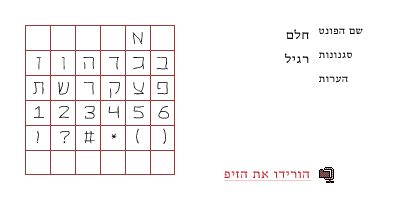
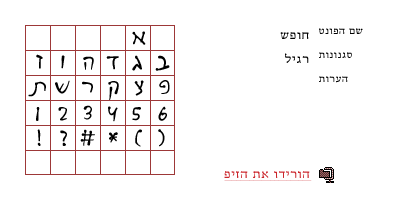
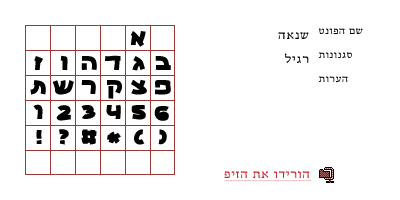
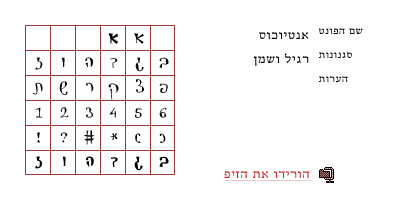
Oketz Hebrew Font - Antiochus Oketz Hebrew Font - Ashem
Oketz Hebrew Font - Busta Oketz Hebrew Font - Helem
Oketz Hebrew Font - Hofesh Oketz Hebrew Font - Kurkevan
Oketz Hebrew Font - PingPong Oketz Hebrew Font - Sinaa


Urban Fonts Store
This is a place to buy fonts. If you search for “Hebrew”, nothing shows up, but yet they have a page with three Hebrew fonts.
I think I used “Seferad AH” from this site to make the banner at the top – it has English letters shaped somewhat like Hebrew letters.

This styles of fonts are called “Faux Hebrew” as explained on Wikipedia: Faux Hebrew is a Latin script typeface that mimics the calligraphic curves and large serif of Hebrew characters.[1] The style is used for decorative purposes, such as in artwork, foreign branding advertisements, and antisemitic propaganda, often to evoke themes of Jewishness or represent Israel.

They formerly had great Hebrew Fonts, as shown below – very decorative – good for banners, posters, Some free for download, some available for purchase, prices vary.

Here were the six fonts they used to have, I currently cannot find them:

MyFonts.com

http://scripts.sil.org/cms/scripts/page.php?site_id=nrsi&id=EzraSIL_Home
The SIL Hebrew Font System (SIL Ezra) provides an integrated, complete system for entering, displaying, and printing Biblical Hebrew texts, including transliteration from Hebrew into Roman text. FREE DOWNLOAD. (SIL was formerly known as the Summer Institute of Linguistics.)

Ezra Sil Font

http://www.tavultesoft.com/keyman/ Travultesoft Keyboard Manager, (Keyman) – FREE trial
– ongoing use may require registration and fee.

http://www.linguistsoftware.com/bhs.htm – Biblia Hebraica Stuttgartensia (BHS) For Use In Any Program
– Biblical Linguists Fonts for sale

A new way to learn the Hebrew Tongue By Andrew Burrell – Despite the name, this book was published in 1739. (Scan of old book, free on Google Docs.)

Good Nir Dagan – Hebrew on the Web – 6 useful links

Many of these are articles are VERY technical – for programmers who need to interpret various Hebrew fonts.

http://www.ietf.org/rfc/rfc1555.txt – Hebrew character encoding for Internet Messages, from the IETF website (Internet Engineering Task Force)

http://www.tavultesoft.com/keyman/ – Travultesoft Keyboard Manager, (Keyman) – FREE trial – ongoing use may require registration and fee. Helps build your own Microsoft Windows Keyboard Map Layouts for Unicode Fonts.

http://www.unicode.org – What is
Unicode? It is a growing standard that uses two-bytes per character to describe international fonts.

The Unicode Standard has been adopted by such industry leaders as Apple, HP, IBM, JustSystem, Microsoft, Oracle, SAP, Sun, Sybase, Unisys and many others. Unicode is required by modern standards such as XML, Java, ECMAScript (JavaScript), LDAP, CORBA 3.0, WML, etc., and is the official way to implement ISO/IEC 10646. It is supported in many operating systems, all modern browsers, and many other products. The emergence of the Unicode Standard, and the availability of tools supporting it, are among the most significant recent global software technology trends.

Incorporating Unicode into client-server or multi-tiered applications and websites offers significant cost savings over the use of legacy character sets. Unicode enables a single software product or a single website to be targeted across multiple platforms, languages and countries without re-engineering. It allows data to be transported through many different systems without corruption.

Typing Hebrew Tutorials

http://HebrewTypingTutorial.com – Learn to touch type in Hebrew, drills start out teaching you just or three letters, then more letters are added each lesson.

Font Utilities

Great http://www.alanwood.net/unicode/ – Alan Wood’s Unicode Resources – Unicode and Multilingual Font and K keyboard Utilities.

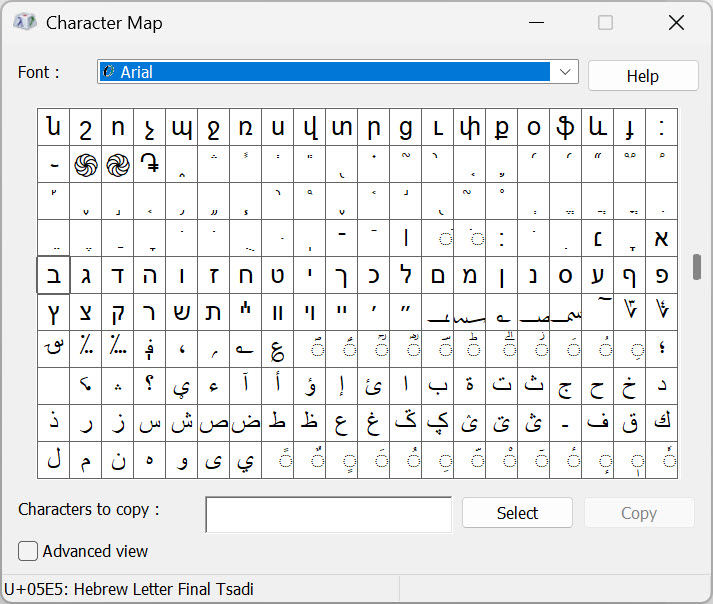
Microsoft WindowsTM – Don’t forget about the simple CHARMAP (Character Map) utility that comes with Windows. It can be found under Start – Program – Accessories, then look around, or try under System Utilities. This allows you to see the unicode character, or copy/paste a letter or nikud from the character map, so you can paste it into another program.


http://heiner-eichmann.de/software/listfont/listfont.htm
– LISTFONT Utility – similar to CharMap above, but very easy to use.
Allows you to change the size of the font being displayed.

http://www.microsoft.com/typography/tools/tools.htm
– TTFDump – intended for developers and font authors. Dumps the internal
characteristics of a True Type Font (TTF) to a text file.

Hebrew web sites.

See if your browser can view the Hebrew letters on these Israeli sites. NOTE: a suffix of “.il” on a web site indicates the country code of “IsraeL”

Country codes often have the first and last letter of the country name.

https://he.wikipedia.org/
http://www.snunit.org.il/
http://www.walla.co.il
http://www.tve.co.il
http://www.isratv.com
http://www.hadashot.com

Posted in Hebrew Letters | Comments Off on Hebrew Fonts

Torah and Laining (Cantillation)

The word “Torah” literally means “instructions” (not “law”), and refers to the instructions given to God to Israel. Torah typically refers to the 5 books of Moses (the “written law”), but some people also use it to refer to the entire Jewish Scriptures (the Tanak) and still others include the “oral law”, i.e. Talmud, as part of Torah.

TaNaK – is an acronym of the Jewish Scriptures. It stands for the following:

T=Torah

N=N’vi’im (the prophets)

K=K’tuvim (the writings)

Torah scrolls are written on lamb skins and the ink is a type of vegetable oil. The reader uses a pointer called a “yad” (literally meaning “hand”). A “yad” is usually a metal or wood “stick” with a hand and a pointing finger on the end. Contact of the words on the Torah scroll with the oils, greases, and chemicals on the human hand can be harmful to the letters.

The Torah was written without vowel points (“nikudot”), which were added to simply, avoid confusion, and to clarify. A good knowledge of vocabulary, and grammar, and some experience should allow a person to read Hebrew without the vowel points.. Like most Israeli signs, many major Hebrew newspapers do not include the vowels. Torah scrolls have decorative ornaments, called “crowns”, added to the tops of many letters. (Actually the Hebrew word means “pomegranates”, from which modern Hebrew gets the word “hand granades”).

Likewise, the original scrolls had no punctuation or book/chapter/verse numbers. However, all Torah scrolls do have identifical formats, . i.e. the same words appear in the same shapes and position on the sames “pages”. A person working with a Torah scroll must learn to recognize the “page layout”, or use a book with that cross-references the Torah page to a page with the vowel and Trup symbols.

A cantor or “chazan” will chant the Torah reading. He uses additional symbols, called Trup or Ta?ameem (plural for the Hebrew word “tahm”, meaning simple or innocent, like the sacrificial lamb). Like vowel points, they appear above or below the letters, and they act as musical symbols, indicating which of the several melodies should be used. There are different tunes for the Torah (books of Moses) and Haftarah (prophets), and each of the writings. Also, Sephardic, Ashkenazi, and other Jewish sects have different cantillation tunes.

Since the Torah scrolls have neither vowel points or Ta?ameem, a cantor study generally prepares from a “tikun” (literally meaning “repair”, “restore”, or “improvement”), a book with the vocalized text (with Ta?ameem) both on one page, across from the other page with the original Hebrew/Torah layout.

The Torah has been divided into weekly “parashot” (parashah, singular). Every synagogue in the world will be reading the same parashah on any given Sabbath. Various men in the synagogue are called to make an “aliyah” (a going up – or call to come forward and read). Typically the man going forward recites a blessing before and after the Torah reading, but lets the Rabbi or Cantor read from the Torah in his stead. There are usually seven “aliyot” (plural of “aliyah”) per service, plus the maftir, who reads the final Torah passage and the Haftarah (a selected reading from the prophets).

Posted in Jewish Prayer | Comments Off on Torah and Laining (Cantillation)

PassoverSongs

1) Who Knows One? (Sung)

2) Who Knows One? – Words said slowly


Sorry – This product is no longer available, it’s a little late to ship this item by the night of the Seder, but you might want to get a jump on next year. Includes the 4 questions (Ma Nishtana), Avadim Hayinu, Dayeinu, Chad Gadya, and Eliyahu HaNavi. This is an audio CD made in Israel. (It does not contain the printed words.) Click here to view product catalog.

3) Adir Hu – Words and partial tune


If you like these Passover Songs, you might be interested in Jewish Liturgy all year round.
This book is well illustrated and covers all the basic prayers. The CD pronounces the prayers for you.

4) Items on the Seder Plate

5) The 10 Plagues

6) The 15 elements of the Seder

Posted in Uncategorized | Comments Off on PassoverSongs

Sample of a 47 Day Detailed Lesson Plan

“At Home With Hebrew – The Holy Language” – Multimedia Windows Hebrew Tutorial Software Program teaches beginners to read and pronounce Hebrew language, and to recognize the most common Hebrew words used in Bible and Synagogue.

For Self-Paced Student or Parents/Teachers of Home-Schoolers

Each “day” is one “computer session”. You might do 5 “days” a week, three “days” per week, or one “day” per week. If you already know the Hebrew Aleph-Bet, you should still do Reading Lessons 1-13 – but you will be able to do them much faster than a beginner.

____ Day 1 – Reading Intro (23 pages) and Reading Lesson 1 (14 pages)
____ Day 2 – Reading Lesson 1 and 2 (13 new pages)
____ Day 3 – Reading Lesson 2 and 3 (13 new pages)
____ Day 4 – Reading Lesson 3 and 4 (21 new pages)
____ Day 5 – Reading Lesson 4 and 5 (8 new pages)
____ Day 6 – Reading Lesson 5 and 6 (10 new pages)
____ Day 7 – Reading Lesson 6 and 7 (15 new pages)
____ Day 8 – Reading Lesson 7 and 8 (9 new pages)
____ Day 9 – Reading Lesson 8 and 9 (11 new pages)
____ Day 10 – Reading Lesson 9 and 10 (8 new pages)
____ Day 11 – Reading Lesson 10 and 11 (13 new pages)
____ Day 12 – Reading Lesson 11 and 12 (11 new pages)
____ Day 13 – Reading Lesson 12 and 13 (7 new pages)

____ Day 14 – Common Word Groupings – Personal Pronouns (16 pages)
& Review Reading Lesson 13
____ Day 15 – Common Word Groupings – Review Day 15 Learn Question Words
____ Day 16 – Common Word Groupings – Review Days 15-16 & Learn Synagogue
& Holiday Words (7 pages)
____ Day 17 – Common Word Groupings – Review Days 15-17 & Learn Prepositions
and Short Words (4 pages)

I suggest all beginners to the above lessons as shown.

At this point you may customize depending on your priorities.
The following lesson plan assume that the students desires an overall feel for the language but
not as much interest in the chanting and liturgy.

You might want to do these on one day or break into two or three days.
Instead of calling the next lesson “Day 19”, you could call it “Unit 19”.

____ Day 18a – Grammar – Nouns (9 pages)
____ Day 18b – Word Family #1
____ Day 18c – Top 400 Biblical Words – Lesson #1

____ Day 19a – Grammar – Adjectives (6 pages)
____ Day 19b – Word Family #2
____ Day 19c – Top 400 Biblical Words – Lesson #2

____ Day 20a – Grammar – Nouns & Adjectives – part 1 (first 7 of 14 pages)
____ Day 20b – Word Family #3
____ Day 20c – Top 400 Biblical Words – Lesson #3

____ Day 21a – Grammar – Nouns & Adjectives – part 7 (last 7 of 14 pages)
____ Day 21b – Word Family #4
____ Day 21c – Top 400 Biblical Words – Lesson #4

____ Day 22a – Grammar – Verbs – Intro & Type 1 (7 pages)
____ Day 22b – Word Family #5
____ Day 22c – Top 400 Biblical Words – Lesson #5

____ Day 23a – Grammar – Verbs Type 2 (5 pages)
____ Day 23b – Word Family #6
____ Day 23c – Top 400 Biblical Words – Lesson #6

____ Day 24a – Grammar – Verbs – Type 3 (7 pages)
____ Day 24b – Word Family #7
____ Day 24c – Top 400 Biblical Words – Lesson #7

____ Day 25a – Grammar – Verbs – Infinitives (9 pages)
____ Day 25b – Word Family #8
____ Day 25c – Top 400 Biblical Words – Lesson #8

____ Day 26a – Grammar – Review as Needed
____ Day 26b – Word Family #9
____ Day 26c – Top 400 Biblical Words – Lesson #9

____ Day 27a – Grammar – Review as Needed
____ Day 27b – Word Family #10
____ Day 27c – Top 400 Biblical Words – Lesson #10

____ Day 28a – Grammar – Review as Needed
____ Day 28b – Word Family #11
____ Day 28c – Top 400 Biblical Words – Lesson #11

____ Day 29a – Numbers – Learn the Letters for 1-9 (one page)
____ Day 29b – Word Family #12
____ Day 29c – Top 400 Biblical Words – Lesson #12

____ Day 30a – Numbers – Learn the Letters for the multiples of 10 (one page)
____ Day 30b – Word Family #13
____ Day 30c – Top 400 Biblical Words – Lesson #13

____ Day 31a – Numbers – Learn the Letters for the multiples of 100 (one page)
____ Day 31b – Reading Lesson #1 in Cursive
____ Day 31c – Top 400 Biblical Words – Lesson #14

____ Day 32a – Numbers – Practice (8 pages)
____ Day 32b – Reading Lesson #2 in Cursive
____ Day 32c – Top 400 Biblical Words – Lesson #15

____ Day 33a – Numbers – Repeat Same Practice (8 pages)
____ Day 33b – Reading Lesson #3 in Cursive
____ Day 33c – Top 400 Biblical Words – Lesson #16

____ Day 34a – Numbers – Words for Feminine Numbers 0-5 (one page)
____ Day 34b – Reading Lesson #4 in Cursive
____ Day 34c – Top 400 Biblical Words – Lesson #17

____ Day 35a – Numbers – Words for Feminine Numbers 6-10 (one page)
____ Day 35b – Reading Lesson #5 in Cursive
____ Day 35c – Top 400 Biblical Words – Lesson #18

____ Day 36a – Numbers – Words for Masculine Numbers 1-5 (one page)
____ Day 36b – Reading Lesson #6 in Cursive
____ Day 36c – Top 400 Biblical Words – Lesson #19

____ Day 37a – Numbers – Words for Masculine Numbers 6-10 (one page)
____ Day 37b – Reading Lesson #7 in Cursive
____ Day 37c – Top 400 Biblical Words – Lesson #20

____ Day 38a – Numbers – Words for Numbers 11-19 (two page)
____ Day 38b – Reading Lesson #8 in Cursive
____ Day 38c – Top 400 Biblical Words – Lesson #21

____ Day 39a – Numbers – Words for Numbers 20-100 (one page)
____ Day 39b – Reading Lesson #9 in Cursive
____ Day 39c – Top 400 Biblical Words – Lesson #22

____ Day 40a – Numbers – Words for Numbers 21-99, 100-1000 (two pages)
____ Day 40b – Reading Lesson #10 in Cursive
____ Day 40c – Top 400 Biblical Words – Lesson #23

____ Day 41a – Numbers – Words for Ordinal Numbers 6-10 (two pages)
____ Day 41b – Reading Lesson #11 in Cursive
____ Day 41c – Top 400 Biblical Words – Lesson #24

____ Day 42a – Days of the Week (one page)
____ Day 42b – Reading Lesson #12 in Cursive
____ Day 42c – Play Phone Game to Help Review Numbers

____ Day 43a – Months of the Year (one page)
____ Day 43b – Reading Lesson #13 in Cursive

____ Day 44a – Words about Time (one page)
____ Day 44b – Writing Cursive

____ Day 45a – Read about “The Jewish Calendar”
____ Day 45b – Writing Cursive

____ Day 46a – Books of the Bible (9 pages)
____ Day 46b – Reading Actual Handwriting

____ Day 47a – Repeat Books of the Bible (9 pages)
____ Day 47b – Reading without Vowel Dots

At this point you could consider the following:
1) Repeating the Grammar Lessons using the Cursive Font
2) Learning the Hebrew Chants (10 pages)
3) Reading the Hidden Hebrew materials (approx 60 pages)
4) Repeating the Reading Lessons 1-13 with the Rashi Font

Related Blogs: Student Tracking & Progress Chart 


Posted in Lesson Plans | Comments Off on Sample of a 47 Day Detailed Lesson Plan

Differences in Biblical and Modern Hebrew

What are the differences and similarities between Biblical and Modern Hebrew?

The best comparison is Shakespeare or King James English to modern English.

They are very similar, but yet different!

If someone called you on your cell phone and said “Wherefore art thou? Did thou changest the oil in thine car?” you would know what they mean, but you would know they are not speaking modern English!

Subject/verb agreement is the same, noun/adjective agreement is the same, direct-object pointer is the same. Word order is more flexible in modern Hebrew. Biblical Hebrew has a few extra things to learn, that have basically been dropped in modern Hebrew; such as the “noun-construct”, the use of possessive suffixes, and verbal suffixes (such as he gave it to me)

Probably the biggest difference is the vocabulary.

The Bible is a book about how God relates to mankind. Also, people 2000-4000 years ago had different things to talk about then people living in the high-tech information world of today.

Here’s a brief Hebrew vocabulary comparison:

Nouns Comparison

Biblical Nouns: king, temple, breast-plate, tabernacle, high-priest, angel

Modern Nouns: car, taxi, airplane, restaurant, waiter, check, steak, fried-chicken, computer, typewiter, television, radio

Nouns common to both: street/road, boat, meat, fish, fruit, tree, honor, love, man/woman, husband/wife

You won’t learn how to order fried-chicken and a soft drink by studying Biblical Hebrew!

Verb Comparison

Biblical Verbs: prophecy, sanctify, punish

Modern Verbs: drive, fly, program

Common Verbs: go, take, love, sit, say, speak, stand, build, honor, judge, buy, sell, learn, teach, borrow, lend, depart

Adjective Comparison

Biblical Adjectives: righteous, sinful, without-blemish, pure, holy, unclean

Modern Adjectives: colorful, technical, rapid

Common Adjectives: fast, slow, dark, bright, good, bad, high, low, beautiful

Letter Styles

Modern Hebrew often requires the student to be able to read and write cursive letters. But this is normally for hand-written notes and letters. Printed books are use the standard style of block letters.

If you read from the Torah scroll, you will recognize the letters, but the are in the Ashurite script or font. In a printed Chumash or Tanak, they are often printed in the same style as modern Hebrew.

Posted in Learning Hebrew | Comments Off on Differences in Biblical and Modern Hebrew